Building Creative Journeys that Grow Over Time
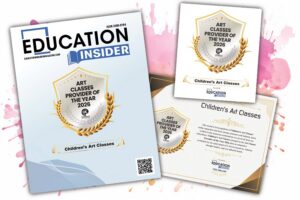
Reprinted with Permission of Education Insider
Children do not learn art in a single class or a short series of projects. They learn it through repetition and sustained practice. At Children’s Art Classes, that long view of learning has shaped the program from the beginning.
Designed for students as young as three and extending through adolescence and beyond, Children’s Art Classes offers structured, studio-based art education that unfolds over years, allowing students to grow steadily while forming a lasting relationship with art.

A School Built from Experience
Children’s Art Classes was founded in 2009 in Jacksonville, Florida, by Barbara Gay, a certified art educator with more than 45 years of teaching experience across public schools and private instruction. Long before opening the first studio, Gay taught art from her garage in New Mexico, where she encountered a recurring problem. Young students dedicated to pursuing art seriously had nowhere to go once introductory classes ended.
When she relocated to Florida to be closer to her daughters, Gay rebuilt the program with that gap in mind. “My goal was designing a curriculum that would allow instruction to deepen year after year,” she says.
When she relocated to Florida to be closer to her daughters, Gay rebuilt the program with that gap in mind. “My goal was designing a curriculum that would allow instruction to deepen year after year,” she says.
She opened the first studio along with her daughter Stephanie, who now leads franchise operations, while her other daughter, Jessica, teaches at one of the Jacksonville locations today.
The program later expanded into a franchise system, now operating across 26 states with 82 territories sold. Gay continues to teach in Jacksonville and is actively involved in teacher training across the franchise. All teachers in its studios are qualified art teachers who receive additional training to deliver the curriculum as intended.
Curriculum Designed for Depth
In Children’s Art Classes’ nine-year progressive curriculum, students move through drawing, painting, design, printmaking, sculpture, clay and mixed media, with each level building on the last to strengthen technical skills while fostering greater creative independence.
Instruction begins with Tiny Hands, a two-year program for ages three and four that introduces easel painting and clay through age-appropriate sessions. Students advance through age-based levels before entering Art One, the foundation course where all students begin regardless of age. It focuses almost entirely on black-and-white work, emphasizing value, line and texture. Color is introduced only after students have developed visual judgment. From there, the curriculum deepens by emphasizing observation, value, line and structure before introducing color and advanced media.
By Art Three, typically around age 11, students are producing work comparable to early college-level study, including multi-color block printing, figure drawing, watercolor landscapes and advanced clay and ink techniques. From Art Four onward, instruction becomes increasingly individualized, allowing students to explore personal direction while applying the technical foundation they have built. As students progress, their work is intentionally preserved and refined into long-term portfolios, supporting competitive college applications and scholarship opportunities.
Learning Extends beyond Technique
While technical instruction is rigorous, the program’s impact extends well beyond artistic skill. Children’s Art Classes are structured to support focus, discipline and self-esteem. These qualities often carry into academic focus and personal development.
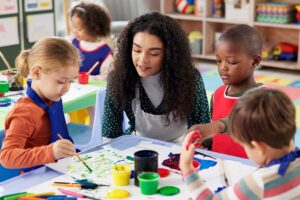
Studios are intentionally calm and serene with classical music playing in the background. Classes are capped at 12 students. Instructors rotate continuously, providing one-on-one guidance and correction.
“Confidence grows when children see improvement they have earned. Students are taught to observe, correct thoughtfully and take pride in their progress,” says Gay.
A Path that Grows with the Student
Children’s Art Classes operates on a nine-month academic cycle from September through May, with students attending weekly sessions lasting one hour and fifteen minutes. Summer workshops extend access to the studio while allowing flexibility outside the school year.
For many students, Children’s Art Classes becomes a long-term creative home. Some discover where their strengths lie and carry that clarity into college or creative careers. A few of them return later as instructors or franchisees, stepping back into the studio in new roles. That continuity is how Children’s Art Classes defines ‘art for life.’